


Introduction
The real estate industry is highly competitive, and potential buyers, tenants, investors, property sellers, and property seekers increasingly begin their search online. Before contacting a real estate company, customers often search on Google, check reviews, explore social media pages, compare locations, and visit company websites. This has made digital marketing an essential part of promoting residential properties, commercial projects, apartments, villas, plots, rental properties, and real estate services.
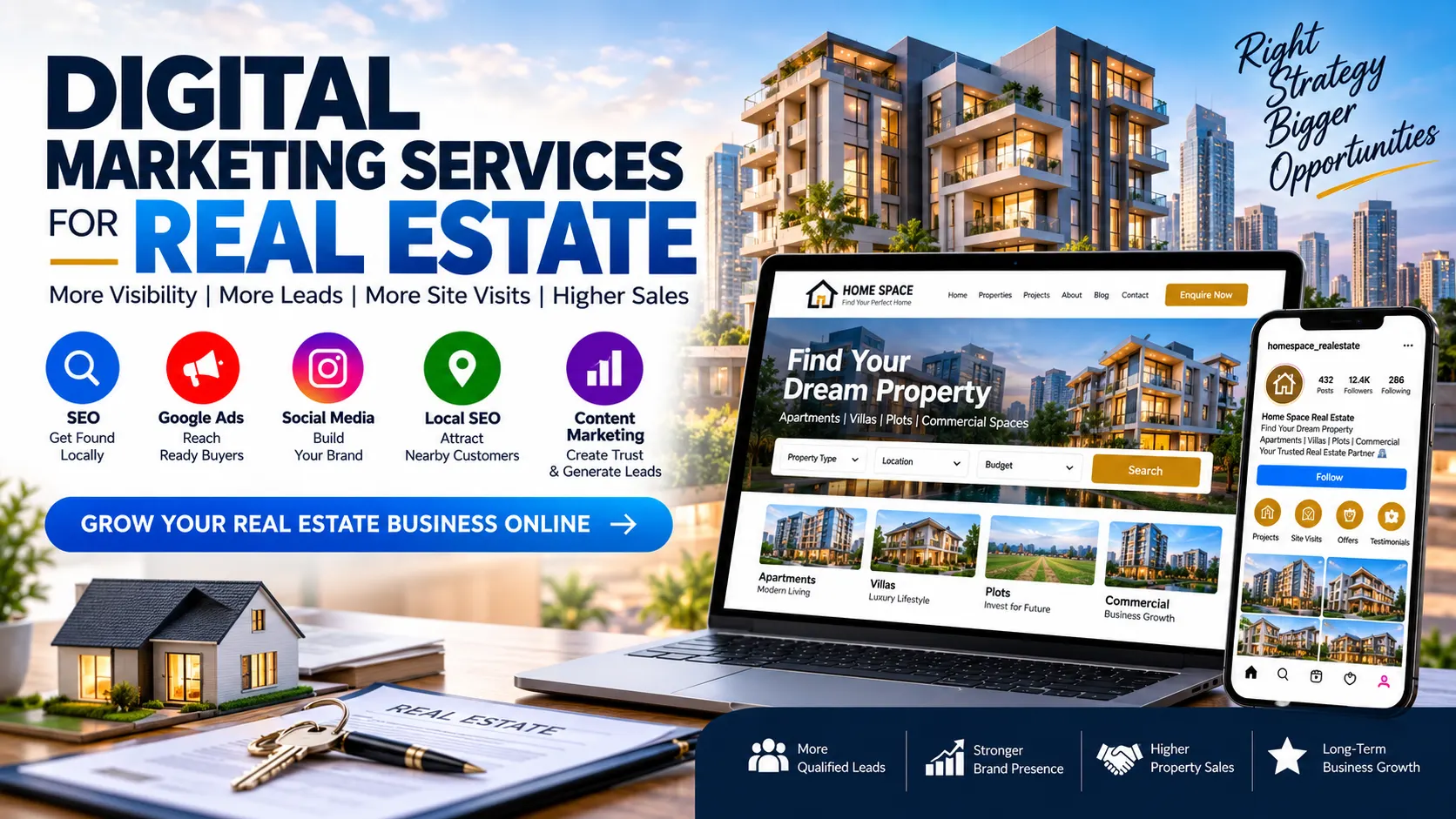
Digital Marketing Services for Real Estate help property businesses improve online visibility, attract qualified leads, promote properties, build brand awareness, and generate enquiries. A complete strategy can include SEO, local SEO, Google Ads, social media marketing, content marketing, website development, property listing optimization, video marketing, reputation management, and lead-generation campaigns. When these channels are integrated properly, a real estate business can create a stronger online presence and a more effective customer journey.
Why Digital Marketing Is Important for Real Estate Businesses
Real estate customers usually conduct significant online research before making a property-related decision. They may search for apartments in a particular location, commercial properties near business districts, plots for sale, rental homes, builders, developers, or real estate consultants. If a property business has limited online visibility, potential customers may discover competing businesses instead.
Digital marketing allows real estate companies to reach customers at different stages of the buying journey. Some users may be researching locations, while others may already be comparing specific properties. SEO can capture organic searches, paid advertising can reach high-intent users, and social media can build awareness. A professional website can then provide detailed property information and convert visitors into enquiries.
Local SEO for Real Estate Companies
Local SEO is particularly important for real estate businesses because property searches are strongly connected to location. Customers often search for terms such as “real estate company in Bangalore,” “apartments for sale in JP Nagar,” “plots for sale near me,” or “commercial property in Bangalore.” Optimizing for relevant location-based searches can help businesses reach potential customers in their target areas.
A strong local SEO strategy should include optimized service pages, location pages, Google Business Profile management, relevant internal links, accurate business information, and useful local content. Each location page should provide unique information rather than simply repeating keywords. Property businesses can discuss connectivity, nearby facilities, property types, local infrastructure, and available services to create useful pages for both customers and search engines.
Real Estate Website Design and Development
A professional website is the central digital asset for a real estate company. It provides a dedicated platform where businesses can showcase properties, explain their services, present projects, publish blogs, display testimonials, and provide contact information. Unlike third-party property portals, a company website allows the business to control its branding and customer experience.
A real estate website should be responsive, fast, secure, and easy to navigate. Property categories should be organized logically, while individual listings should provide detailed information about location, property type, size, amenities, photographs, floor plans, and other relevant details. Strong calls to action such as “Enquire Now,” “Schedule a Site Visit,” “Get Property Details,” and “Contact an Expert” can encourage visitors to take the next step.
Search Engine Optimization for Real Estate
SEO helps real estate websites improve their organic visibility for relevant searches. A properly optimized website can target keywords related to property types, locations, real estate services, projects, and customer requirements. SEO should cover technical optimization, content, page structure, internal linking, image optimization, metadata, and other website elements.
Keyword mapping is especially important for real estate SEO because businesses often have many similar services and locations. A homepage should not compete with every service page, location page, and blog article for the same keyword. Each important page should have a clearly defined search intent and primary keyword. This helps create a structured website architecture and reduces the possibility of keyword cannibalization.
Google Ads for Real Estate Lead Generation
Google Ads can help real estate businesses reach users who are actively searching for properties or related services. Search campaigns can target queries involving property types, locations, project names, real estate services, and other commercial-intent keywords. This can provide additional visibility while organic SEO efforts are developing.
Real estate advertising campaigns should be structured according to different customer requirements. For example, separate campaigns can be created for apartments, villas, plots, commercial properties, rental properties, or specific projects. Each advertisement should ideally direct visitors to a relevant landing page rather than a generic homepage. This creates a more focused experience and can make it easier for users to submit an enquiry.
Social Media Marketing for Real Estate
Social media provides real estate businesses with a powerful platform for showcasing properties and building brand awareness. High-quality property photographs, walkthrough videos, project updates, location content, customer stories, construction progress, and educational posts can keep audiences engaged. Instagram, Facebook, YouTube, and other platforms can be used according to the target audience and content strategy.
Real estate social media marketing should not consist only of property advertisements. Educational content can help establish expertise and attract people who are researching the market. Businesses can publish posts about home-buying tips, property investment considerations, location advantages, documentation basics, property maintenance, and market-related information. Promotional content can then be integrated into this broader content strategy.
Content Marketing Strategy for Real Estate
Content marketing can help property businesses attract users before they are ready to make a direct enquiry. People may search for information about the best locations to live, factors to consider before buying a property, apartment amenities, commercial property requirements, or investment considerations. Useful blog content can bring these users to the company’s website and introduce them to its services.
A successful real estate content strategy should be organized around search intent. Informational blog posts should answer genuine customer questions and provide useful information rather than simply repeating keywords. Relevant articles can internally link to commercial pages, property listings, project pages, and location pages. This creates a natural path from information discovery to property enquiry.
Property Listing Optimization
Property listings are one of the most important elements of a real estate website. A listing should provide enough information for visitors to understand the property without making the page unnecessarily complicated. Property titles, descriptions, photographs, location details, specifications, amenities, floor plans, and enquiry options should be presented clearly.
Search filters can make large property inventories easier to browse. Depending on the business model, users may want to filter properties by location, budget, property type, number of bedrooms, size, amenities, or availability. Individual property pages should have unique content and descriptive URLs so that users and search engines can understand what each page represents.
Video Marketing for Real Estate Businesses
Video has become an important part of property marketing because it allows potential customers to experience a property remotely. Real estate companies can create property walkthroughs, project tours, neighborhood videos, construction updates, agent introductions, and short educational videos. These can be distributed through YouTube, Instagram, Facebook, and the company website.
High-quality video content can showcase aspects of a property that photographs may not communicate effectively. A walkthrough can demonstrate room layouts, natural lighting, amenities, entrances, common areas, and surrounding environments. Videos should be informative and professionally presented, while important contact and enquiry information can be included to encourage viewers to take action.
Social Media Advertising for Property Leads
Organic social media helps build visibility, while paid social advertising can provide targeted reach. Real estate businesses can use advertising campaigns to promote specific properties, new projects, open-house events, property launches, rental opportunities, or other relevant offers. Campaigns can be structured according to location, audience characteristics, and business objectives.
Landing pages are important for converting advertising traffic. A user clicking an advertisement for a specific apartment project should ideally arrive at a page containing information about that project. The page can include photographs, specifications, amenities, location information, and an enquiry form. Tracking leads and conversions allows businesses to understand which campaigns are generating meaningful enquiries.
WhatsApp Marketing for Real Estate
WhatsApp can provide a convenient communication channel for property enquiries. Customers may want to ask about pricing, availability, floor plans, site visits, project details, or property specifications. A WhatsApp button placed on property pages can allow visitors to start a conversation without searching for contact details.
Real estate businesses can also use WhatsApp for appropriate customer communication, such as sharing requested brochures, confirming site visits, providing project information, or following up on enquiries. Messages should be relevant and respectful, and businesses should avoid excessive promotional communication. Fast responses can be particularly useful when potential customers are comparing multiple properties.
Online Reputation Management for Real Estate
Trust is an important factor in property-related decisions. Customers may research a real estate company by checking Google reviews, testimonials, social media profiles, and other online information. A professional online reputation can provide additional confidence when customers are deciding whether to contact a business.
Real estate companies should encourage genuine customers to share honest experiences and respond professionally to feedback. Positive reviews can provide social proof, while thoughtful responses to negative feedback can demonstrate that the business takes customer concerns seriously. Reputation management should be supported by actual service quality and accurate property information.
Mobile-Friendly Digital Marketing for Real Estate
A large portion of property research takes place on smartphones. Customers may browse property listings while travelling, compare locations, watch property videos, or contact agents directly from their mobile devices. A website that is difficult to use on a smartphone can create unnecessary friction and cause visitors to leave.
A mobile-friendly real estate website should have responsive layouts, readable text, properly optimized images, simple menus, fast-loading pages, and clearly visible contact options. Property galleries and enquiry forms should work smoothly on smaller screens. Mobile optimization should be considered as part of the overall website development process rather than treated as a separate feature.
Digital Marketing for Builders and Property Developers
Builders and developers often require a more comprehensive digital marketing strategy because they may promote multiple projects over an extended period. Project-specific websites or landing pages can provide information about floor plans, amenities, specifications, construction status, location advantages, and other relevant details.
Digital campaigns can be created around new project launches, sample apartment visits, project updates, or specific inventory. SEO content can target project-related and location-based searches, while Google Ads and social media advertising can generate additional enquiries. A strong digital strategy can keep a project visible throughout different stages of its marketing cycle.
Real Estate Lead Generation and Conversion Strategy
Generating website traffic is only one part of digital marketing. Real estate businesses also need systems that encourage visitors to become enquiries. Clear calls to action, enquiry forms, phone numbers, WhatsApp buttons, brochure requests, site-visit forms, and callback options can help convert interested visitors.
The enquiry process should be simple and relevant. Forms should avoid asking for unnecessary information at the initial stage. Businesses can also use analytics and conversion tracking to understand which pages, campaigns, keywords, and advertisements are generating enquiries. This information can be used to improve marketing activities and website performance over time.
Measuring Digital Marketing Performance for Real Estate
Digital marketing should be measured using meaningful business metrics. Real estate companies can track organic traffic, keyword visibility, website enquiries, phone calls, WhatsApp conversations, brochure requests, site-visit bookings, advertising leads, conversion rates, and customer acquisition costs. These metrics provide a clearer picture of marketing performance than social media engagement alone.
Regular reporting can identify which channels are generating valuable opportunities. For example, SEO may generate consistent organic enquiries, while paid advertising may produce immediate leads for a new project. Social media may contribute to brand awareness and remarketing opportunities. Understanding how different channels contribute to the customer journey allows businesses to refine their digital marketing strategy.
Choosing Professional Digital Marketing Services for Real Estate
Every real estate business has different requirements based on its location, property portfolio, target audience, budget, and business model. A real estate agency may focus on local SEO and property listings, while a builder may need project marketing, Google Ads, social media campaigns, landing pages, and video content. Therefore, digital marketing should be planned around specific business objectives.
Professional Digital Marketing Services for Real Estate should ideally combine SEO, website optimization, content marketing, social media, paid advertising, local search, reputation management, and lead generation. These activities should support one another rather than operate independently. A coordinated strategy creates a more consistent brand experience across search engines, websites, social media platforms, and communication channels.
Benefits of Professional Digital Marketing for Real Estate
A well-planned digital marketing strategy can help real estate businesses improve online visibility, attract relevant audiences, generate property enquiries, promote projects, strengthen brand awareness, and maintain a professional digital presence. It can also help businesses reach customers beyond traditional referral networks and offline advertising.
Digital marketing creates long-term assets for a property business. An optimized website, useful blog library, strong local presence, quality property content, genuine reviews, and established social media channels can continue supporting marketing efforts as the company grows. Consistent optimization and performance tracking can help businesses adapt their strategy as customer search behavior and market requirements change.
How Digital Marketing Can Support Real Estate Business Growth
A potential property customer may discover a company through Google, visit a location page, explore property listings, watch a project video, check reviews, and contact the business through WhatsApp. Every part of this journey contributes to the customer’s overall experience. Digital marketing works best when these touchpoints are connected and provide consistent information.
Real estate businesses can use digital marketing to build visibility before customers are ready to enquire and maintain communication as they move closer to a decision. By combining SEO, local search, content marketing, paid advertising, social media, video, website optimization, and lead management, property businesses can build a structured digital ecosystem around their brand.
Conclusion
Digital Marketing Services for Real Estate have become an important part of modern property marketing. Buyers, sellers, tenants, investors, builders, and developers increasingly use digital channels to discover information, compare options, evaluate businesses, and initiate conversations. A strong online presence can therefore support both brand visibility and lead generation. From real estate SEO and local SEO to Google Ads, social media marketing, content creation, property listing optimization, video marketing, website development, WhatsApp marketing, and reputation management, each channel can play a specific role in the customer journey. The most effective approach is to build an integrated strategy with clear goals, unique keyword targeting, useful content, strong conversion paths, and regular performance measurement.
